
Understand the big picture
 | |||
| Follow us... | |||
 |  | ||
| Published: | 2017-Mar-01 |
| Last Updated: | 2017-Jul-18 |
| Principal Writer: | Barry Shatzman |
 | Understanding The Issue |
 | House Bill |
| Senate Rewrites |
| Issue Status |
| Analysis and Perspectives |
| More Information |
American Health Care Act
2017 (HR-1628)
American Health Care Act (House)2017 (HR-1628H)
Better Care Reconciliation Act2017 (HR-1628S)
Patient Protection & Affordable Care Act2010 (HR-3590)
We gotta ask...
DID YOU JUST LEARN SOMETHING?
Is it worth a dollar?
News in FiVe is free to read, but it takes time and money to publish.
If you find what we do valuable, please help us continue with a small donation.
Even a dollar or three every so often makes a difference.
It's secure and takes only about a minute.
Thanks!
The first major attempt by the House (and Senate)
This section explains the bill passed by the House (American Health Care Act) as well as modifications the Senate first proposed.
The Senate's changes did not gather enough support to pass, and Republican leadership gave up trying to pass it. In the section following this one, we explain subsequent attempts by Senate Republicans to eliminate Obamacare and its protections.
A few protections remain in place
First, a few bits of good news... some protections that were created by Obamacare would not necessarily change...
o Insurance companies could not rescind your coverage because you become sick.
o Policies still would need to cover essential health benefits (though we'll explain how this protection is weakened).
o Children under age 26 would be able to remain covered under a parent's policy.
o You could not be denied coverage or charged more for pre-existing conditions (though those with pre-existing conditions likely would end up paying much more - as we'll explain below).
Key protections are not guaranteed
Individual states would to be allowed to waive some key protections...
Essential Benefits
States would be allowed to exempt insurance companies from providing those benefits.
Reducing coverage requirements (thus reducing the value of the insurance) would save some people a little bit of money, but would cost others much more. We explain in the Our Analysis and Actions section of this discussion.
Pre-existing conditions
Under the House version, states could allow companies to charge higher premiums to those with pre-existing conditions who have gone a period of time without coverage, if a the state maintained a high-risk pool.
Allowing insurance companies to discriminate against those with pre-existing conditions would reduce premium costs for some. But even with state-provided high-risk pools, many less healthy individuals would be unable to obtain health care coverage. We explain in the Our Analysis and Actions section of this discussion.
Out-of-pocket protections could be severely weakened
Obamacare offered protections against catastrophic costs in two ways. The first was by eliminating lifetime caps and annual caps on how much an insurance company would pay. The second was imposing out-of-pocket maximums on how much you would be required to pay.
The replacement bills keep these intact. Sort of.
Those limits are for essential health benefits only. Under Obamacare, virtually everything was covered under an essential health benefit, so those limits applied to virtually everything.
Under the either of the replacement bills, states effectively would be able to define their own benefit requirements. If a benefit (such as maternity and newborn care) is not required by a state, then those protections would not be in effect for those services.
For more, read this explanation by the Brookings Institution.
Stark differences in helping you pay for insurance
Obamacare provides assistance to help cover the cost of insurance.
Both proposals also would provide assistance, though each in a different way. Both provide significantly less help than Obamacare.
(Note that the bills refer to assistance in different ways. For example, the AHCA calls for refundable tax credits to help you pay for insurance. Obamacare does it somewhat differently. Because the final result works out the same regardless of the method, we'll keep this comparison simple by referring to the benefit in each as assistance.)
Obamacare
Under Obamacare, the amount of assistance depends on family income and the cost of insurance. Someone earning between 1-4 times the federal poverty level ($12,000 - $48,000 a year for an individual) receives assistance from the government to help pay for their premium.
The amount is tied to the cost of insurance, so even if premiums make a huge jump (as some did in 2017), those earning less than four times the federal poverty level will have much of that increase covered.
It's important to note that someone earning less than the federal poverty level is not eligible for assistance. They are however, eligible to receive health care under Medicaid Expansion (unless they live in a state that refused it).
House Proposal
Under the AHCA plan, the amount you receive would depend only on your age...
| Under 30 | $2,000 |
| 30 - 40 | $2,500 |
| 40 - 50 | $3,000 |
| 50 - 60 | $3,500 |
| 60 and over | $4,000 |
Assistance would be reduced for individuals who earn more than $75,000 in a year.
Each year, the amount of the assistance would increase - tied to the Consumer Price Index (CPI). The cost of health care, however, has been increasing faster than the overall cost of living. So with each year, the amount of your assistance would cover less and less of your health care costs.
Senate Proposal
The BCRA would offer assistance similar to Obamacare (based on income and the cost of insurance). However, the amount would be less. That is because it would be determined based on a lower metal level policy (bronze for BCRA vs silver for Obamacare).
Also, assistance under the BCRA would stop at those earning 3.5 times the federal poverty level (versus 4 times the federal poverty level for Obamacare).
So what does all this really mean for me?
House Proposal
As with any public policy, some people are helped more than others. This chart shows how the change in assistance for the AHCA would directly affect people...
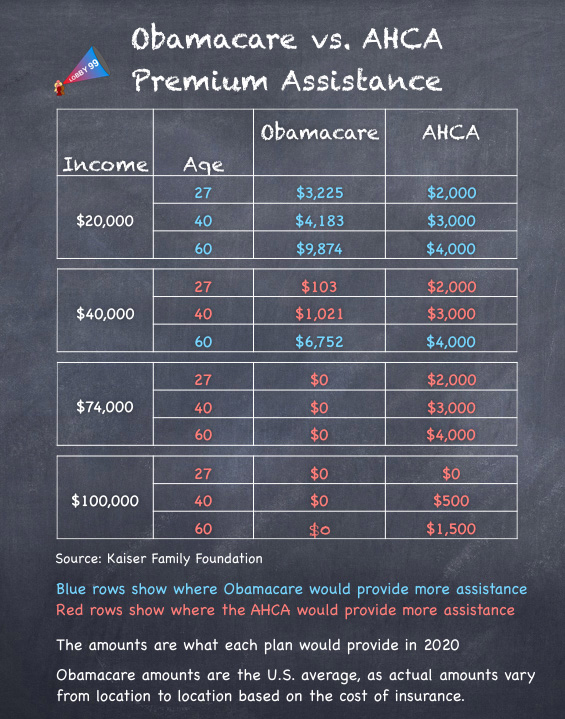
Low-income and older people are helped more by Obamacare. The younger you are and the higher your income, the more likely the AHCA would be to provide more assistance.
Senate Proposal
Though most people would receive less assistance under the BCRA than under Obamacare, there is one set of people who would benefit. Those are people earning less than the federal poverty level who live in a state that has refused Medicaid Expansion.
Those people currently receive no assistance. They would receive assistance to buy insurance under the BCRA.
Note though, that those earning less than the federal poverty level who live in states that have accepted Medicaid Expansion receive virtually free health care under Obamacare.
Premiums for older people will increase more
The amount of assistance is only part of the equation of what you pay for insurance. Premium costs matter too - especially since the House proposal would not account for premium cost (it depends solely on age).
All three health care policies allow insurance companies to adjust premiums based on the age of the insured person. Under Obamacare, the maximum an older person can be charged is 3 times the amount charged to a younger person. Under the both the AHCA and BCRA, that would increase to 5 times the amount (states could restrict that).
This would allow insurers to reduce premiums for younger people - since they would be able to charge higher premiums to older people.
The detrimental effect on older people would be magnified under either proposal however...
o The Senate proposal provides less assistance - meaning for the same cost would result in a lower quality plan. That would require more out-of-pocket expenses for older people (who usually require more expensive care).
Premiums will be lower, but your expenses will soar
If you manage to stay perfectly healthy during the year and don't need to see a doctor, then your health care expenses basically are the insurance premiums you pay.
But if you get sick, have an accident, or are living with a disease such as diabetes or cancer, you'll pay more. No plan covers all of your expenses. They all include conditions such as copayments and deductibles.
Insurance policies under Obamacare are required to have an actuarial value of at least 60 - meaning that even the lowest rated plans would cover at least 60 percent of health care costs on the average.
Obamacare also provides additional cost-sharing assistance for those with incomes less that 2-1/2 times the federal poverty level.
The House and Senate proposals eliminate the minimum restriction on actuarial value. That would allow insurance companies to offer policies with a lower premium, but that will cost you more if you find yourself with a problem needing medical attention. They also would eliminate the cost-sharing assistance that Obamacare provides.
How much will it cost you?
This chart shows an estimate of how much more you are likely to pay for health care in 2020 and 2026 if the AHCA (House proposal) is enacted to replace Obamacare...
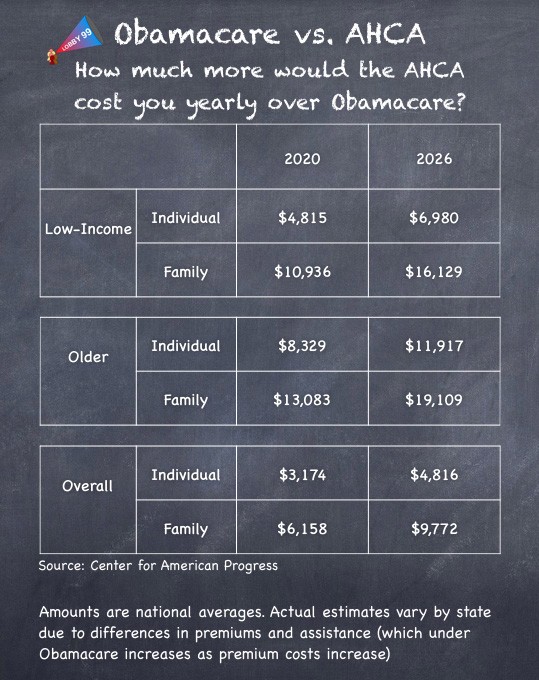
The amounts take into account the following...
o Plans would pay for less of the total cost, meaning you will be responsible for a higher percentage of your health care costs.
o Assistance under Obamacare is related to the premium cost. Under the AHCA, assistance would vary only by age.
It's worth noting that the overall figures are lower than those for low-income and older Americans. That means that low-income and older Americans would feel the most cost impact from the AHCA.
There currently are no such estimates for the Senate version, as it was drafted in secrecy and released just a few days ago. However, since it would provide less assistance, we have no reason to assume that healthcare costs to most Americans would decrease.
Click here to read the Center for American Progress study and explanation the estimated differences in costs to you.
Eliminating the mandate will increase costs
The most attacked feature of Obamacare was the mandate - the requirement that virtually everyone obtain health care insurance that meets standards established by the law. The requirement is enforced by a penalty tax on those who choose to remain uninsured.
We previously had explained why the mandate is a critical component that makes sure the system works for most people.
House Proposal (AHCA)
The House proposal would impose no legal requirement to buy health care insurance. Instead of a legal mandate, the AHCA would attempt to encourage people to have insurance by allowing insurance companies to charge a penalty to those who have not been covered for two or more months and who later apply. The penalty would be an additional 30 percent of the premium cost for a year.
Once somebody had been uninsured for two months, it wouldn't matter how much longer they remain uninsured. The penalty still would be limited to one year. That could encourage someone - especially if they're young and healthy - to stay uninsured as long as possible. As a result, those who buy insurance would be likely to be those with health problems. They're the people who cost insurance companies the most, which means companies would need to increase premium costs to make a profit.
And remember, the amount of assistance you would receive under the AHCA is not linked to premium cost as it is under Obamacare - meaning the money for the increased rates would come directly from your pocket.
Senate Proposal (BCRA)
The Senate version originally eliminated any requirement to purchase insurance. However, it was changed so that anyone who goes more than 2 months without insurance would be required to wait 6 months before they could be guaranteed coverage again.
Final thought...
Those who choose to remain uninsured run the risk of encountering an unexpected serious illness or accident that would be impossible for them to afford. The result either is they (or a family member) do not get treated, or the treatment is paid for by someone else, such as taxpayers. For more on this see our discussion of health care policy.
Companies would no longer be required to provide coverage
Under Obamacare, companies with more than 50 full-time employees are required to offer health care coverage to their employees. Those who don't must pay a penalty.
Both the House and Senate proposals would eliminate the penalty, thus eliminating the requirement that companies offer health care coverage.
Those with pre-existing conditions would pay more for their care
One popular feature of Obamacare - also included in the AHCA - is that insurance policies offered on the exchanges cannot discriminate against those with pre-existing conditions.
The House and Senate proposals, however, would open a loophole for insurance companies that is not available under Obamacare.
Under Obamacare, insurance companies are required to offer plans that would cover at least 70 percent and 80 percent of covered expenses. That requirement would be eliminated.
Those policies are, of course, more expensive than policies that cover less. They are preferred by older and less-healthy people. Younger healthy people prefer policies that would cover less, but also cost them less.
Without the requirement to offer more robust policies, insurance companies could make only the lower quality policies available. Older and sicker people still could purchase those policies, but they would find themselves paying much more of their own money for care than they would have under Obamacare.
Sen. Ted Cruz has proposed an amendment to the Senate's bill that would allow insurance companies to offer very cheap plans that offer minimal practical coverage - provided they offer at least one other plan that would meet the requirements for Obamacare. This would allow the youngest and healthiest to buy the cheapest coverage (possible with no tangible value to them). Those who actually need insurance would be the only ones purchasing the better coverage - which would make that coverage much more expensive. Cruz named the amendment the Consumer Freedom Amendment.
Some protections for those with pre-existing conditions still would remain. The proposals still would keep in place annual out-of-pocket maximum costs, as well as prohibitions against lifetime benefit caps.
Note that under the House proposal, this assumes you live in a state that would allow the protection to remain. If your state legislature and governor chose to exempt insurance companies from this provision, those with pre-existing conditions likely would pay even more.
The most help for the poorest would be phased out
Those who make less than the poverty level don't receive assistance for buying insurance under Obamacare. Instead, they're provided virtually free health care under the Medicaid Expansion program.
Although the federal government pays the bulk of the cost to expand Medicaid, several states did not accept it - leaving their poorest residents without health care.
Under the House proposal, those who live in states that have expanded Medicaid and who are in the program as of 2020 will be able to remain covered by Medicaid Expansion as long as their income remains below the poverty level. The federal government would not pay to cover new people under the program. Also, if someone currently covered by Medicaid Expansion becomes ineligible for more than a month after 2020, that person would not be able to receive the coverage again.
The Senate proposal is similar, except the phase-out would begin later than 2020. In order for the bill to be enacted, both Houses would need to agree on the exact timetable.
In either case though, the Medicaid Expansion program would be phased out by attrition.
What about Medicaid itself?
The phasing out of Medicaid Expansion leaves states entirely on their own to decide eligibility (they effectively have that control under Obamacare because they are able to refuse the expansion).
Even without Medicaid Expansion, the amount of money the federal government provides to states for their Medicaid programs is based on the cost of healthcare.
Under both proposals, the federal government would provide a set amount - such as a per capita amount or a a block grant - to states to pay for Medicaid.
This is likely to leave states with large shortfalls in providing health care through their Medicaid systems.
Most of the cost savings would go to the wealthiest
By cutting benefits that Obamacare provides, the federal government would spend about $1 trillion less in the next 10 years.
That isn't how much more money we'll have though, as the bill also cuts out about $900 billion of revenue. That revenue is part of Obamacare and is used to help pay for the law's provisions.
o Obamacare added a 3.8 percent Net Investment Income Tax for individuals with incomes greater than $200,000.
o Companies can deduct from their taxable income salaries they pay executives up to $1 million per executive. Obamacare limits that deduction for healthcare-related companies to earnings under $500,000.
o Annual fees on pharmaceutical manufacturers and insurance companies would be eliminated.
o Tax penalties collected from those who don't purchase required insurance (Mandate tax) are used to keep prices lower.
The AHCA eliminates all of these revenue sources. It also removes the restriction on how much can be deducted for high-salary employees - allowing those companies larger tax cuts and eliminating a disincentive for them to pay executives more than $500,000 a year.
The BCRA originally eliminated them too. In the current iteration, the two taxes on incomes greater than $200,000 would remain. The restriction on how much healthcare-related companies can deduct from their taxable income for high-salaried employees also would remain inplace.
Effectively, while those with the lowest incomes would end up paying more for health care or going without, those with the highest incomes would receive virtually all of the financial benefits.
For details on these tax cuts, see the Committee for a Responsible Federal Budget analysis.
For more, read this Atlantic article and this Vox article.
For more on the loosening of restrictions on insurance company executive salaries read the Los Angeles Times article.
One fifth of non-elderly Americans uninsured in 10 years
House Proposal (AHCA)
The Congressional Budget Office (CBO) estimates that by 2026, 20 percent (1 out of 5) Americans under age 65 would be uninsured. Under Obamacare, that number is estimated to be just half that (1 out of 10).
Over the next three years, even though the basic provisions of Obamacare would remain in place, the number of uninsured still would increase. Most would be by choice - as some would choose to be uninsured without having to face the penalty tax of the Obamacare mandate. For others, their employer might choose to not offer coverage.
The major provisions of the law (changing the ways assistance is determined, reductions in Medicaid) would take effect in 2020. Once that takes place, the CBO estimates that more than 20 million people who would have health insurance under Obamacare would be without coverage under the AHCA.
The CBO also expects that, over time, fewer employers would offer health insurance to their workers.
For more information...
Click here to read the Congressional Budget Office analysis of the AHCA.
Click here to continue to the next section of this issue...